FLC Series Street Light Selection Guide

FLC Series Street Light Selection Guide

FLC Series Street Light Selection Guide

Choosing among led street lights is really a road-class decision: carriageway width, pole height, spacing and target illuminance set the power step and optics you need long before price enters the conversation. The VIS-FLC Series covers that range in a single platform — 25W to 100W, 5,500 to 22,000 lm and up to 220 lm/W — with Type II and Type III asymmetric optics at 145°×75°. For projects where led lighting has to be specified once, installed once and maintained for a decade, this guide maps each road scenario to an FLC configuration, then to the documentation that supports it.

VIS-FLC Series LED Street Light – Ultra High Efficacy 220 lm/W,MY SHOP,VIS-FLC Series LED Street Light – Ultra High Efficacy 220 lm/W

    Road-Class Selection Matrix

    Turn a road description into a starting configuration. The table below pairs the applications published for the FLC Series with the power step and rated output that matches them, then lists the full specification so the numbers can go straight into a spec sheet.

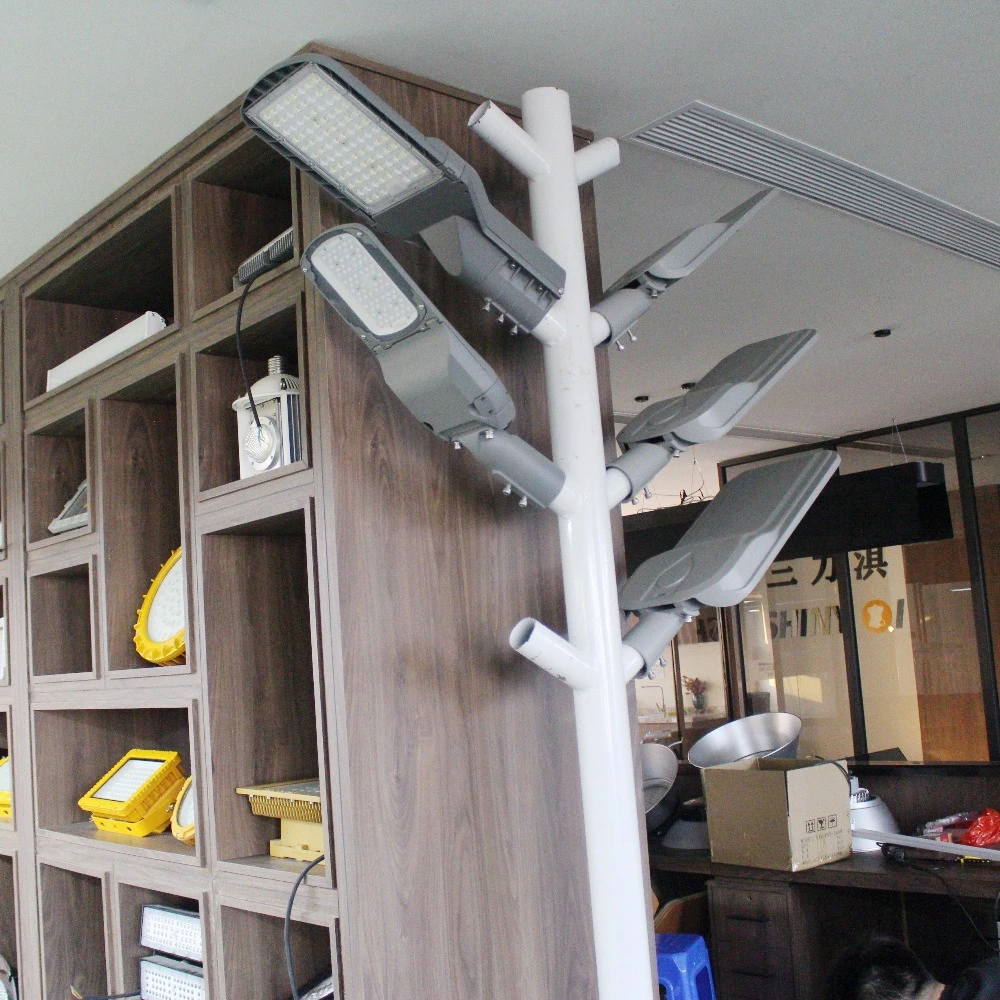
    FLC Series LED street light with die-cast aluminium housing and asymmetric roadway optics

    VIS-FLC Series — one housing platform, four power steps, one set of Type II / Type III optics.

    How to read the matrix

    Each power step on the product page is published next to a rated output: 25W with 5,500 lm, 50W with 11,000 lm, 75W with 16,500 lm and 100W with 22,000 lm. Those four pairings are the anchor for every decision below — pick the row that matches your road context, then confirm it with a photometric layout before it goes into a tender.

    • The road context column uses only the applications published by the manufacturer: urban roadways, residential sidewalks, parks, campuses, commercial facilities, parking lots, distribution parks and rural street lighting.
    • The power step column is a planning starting point, not a lighting design result.
    • Optics and mounting carry across every power step, so they are chosen after the wattage is fixed.
    Road context → FLC configuration starting point
    Road context (published application) Power step Rated output Optics options Mounting
    Residential sidewalk / local residential lane 25 W 5,500 lm Type II Φ60 mm side-entry or post-top
    Park path / campus walkway 50 W 11,000 lm Type II Φ60 mm side-entry or post-top
    Commercial facility / parking lot aisle 75 W 16,500 lm Type II or Type III Φ60 mm side-entry or post-top
    Urban roadway / distribution park 100 W 22,000 lm Type III Φ60 mm side-entry or post-top

    Buyer decision: fix the power step from the target illuminance and pole spacing your designer calculates, not from the row above. The rows exist to narrow the conversation to one or two configurations before a layout is run.

    Full FLC Series specification

    Model designation FFR
    Power 25 W / 50 W / 75 W / 100 W
    Luminous flux 5,500 lm / 11,000 lm / 16,500 lm / 22,000 lm
    Luminous efficacy Up to 220 lm/W
    Color temperature 3000K / 4000K / 5000K / 6000K, customizable
    Color rendering index CRI Ra > 75
    Optics Type II / Type III asymmetric distribution, 145°×75°
    Input voltage AC 110–265 V, 50/60 Hz
    Power factor > 0.95
    Driver efficiency > 90%
    Total harmonic distortion THD < 7%
    EMI compliance EN55015
    Housing material High-quality die-cast aluminium
    Housing color Black / Grey / Custom
    Mounting Side-entry Φ60 mm / post-top
    Operating temperature −20°C to +60°C
    Lifespan 50,000 hours
    Warranty 5 years
    Certifications CE, RoHS

    Buyer decision: use this table as the copy-paste block for your specification document, and request the configuration-specific datasheet with your quote so the model code matches the delivered build.

    Optics Selector: Type II vs. Type III

    Both options are asymmetric distributions published at 145°×75°, built to shape a precise beam pattern across the carriageway while limiting glare. The choice between them is driven by road width and pole position, not by wattage.

    Type II

    Narrow carriageway, pole at the road edge

    The right starting point when the pole stands close to the kerb and the beam has to reach across a short span without over-spilling into frontages or footpaths. It suits residential sidewalks, local lanes, campus walkways and parking aisles where the fixture is close to the area being lit.

    • Best fit: 25 W and 50 W FLC steps on short spans
    • Watch for: light trespass onto adjacent property
    • Decision: keep spacing tight rather than increasing wattage
    Type III

    Wider carriageway, longer pole spacing

    The right starting point when poles are spaced further apart or the carriageway is wider, so a longer forward throw is needed to hold uniformity between columns. It suits urban roadways, commercial frontage roads, distribution parks and parking lots with wide aisles.

    • Best fit: 75 W and 100 W FLC steps on wider spans
    • Watch for: uniformity and glare at the pole nearest the observer
    • Decision: confirm spacing with a layout before fixing the wattage
    Pole at the road edge, span under one carriageway width? Start with Type II.
    Poles spaced apart, dual carriageway or wide frontage? Start with Type III.
    Mixed road widths in one project? Specify the optic per segment and order both variants.

    Buyer decision: request the photometric file for the exact configuration you intend to specify so your designer can verify uniformity ratios and glare limits against local requirements before the tender is published.

    Efficacy Reality Check: 220 lm/W in Real Projects

    Efficacy is only useful once it is expressed as output at a fixed wattage. The FLC Series is rated up to 220 lm/W, and the published power-to-flux pairings make that concrete for budgeting and for energy comparisons.

    Rated luminous flux by power step, as published in the FLC Series specification.

    Energy per fixture per year

    Calculated from the rated wattage at 12 burning hours per night over 365 nights — use it to size the running cost of a pole before any pole is ordered.

    Power step Rated output kWh / fixture / year
    25 W 5,500 lm 109.5 kWh
    50 W 11,000 lm 219.0 kWh
    75 W 16,500 lm 328.5 kWh
    100 W 22,000 lm 438.0 kWh

    Buyer decision: multiply the row that matches your layout by the number of poles, then compare it with the running cost of your existing installation. The manufacturer states that the series reduces energy consumption and maintenance compared with traditional HPS or older LED fixtures; the figures above let you size that comparison against your own baseline.

    • CRI Ra > 75Color rendering for CCTV and facial recognition conditions
    • Driver > 90%Efficiency of the high-efficiency driver
    • PF > 0.95Power factor for utility-friendly loading
    • THD < 7%Low harmonic distortion on the network

    Note on methodology: 220 lm/W is the rated efficacy published for the series. Delivered efficacy on a completed installation depends on the installed optics, drive current, ambient temperature and maintenance regime, so validate it with the photometric layout for your specific road.

    Housing, Thermal & Durability

    A roadway fixture is bought on its mechanical envelope as much as its photometry: what it is made of, how it handles heat and how long it is expected to stay in service before a maintenance crew visits.

    Die-cast aluminium housing

    The body is high-quality die-cast aluminium, described as corrosion resistant and UV stable — the properties that matter on exposed poles cycling through sun, rain and salt air.

    Material

    Thermal envelope −20°C to +60°C

    The published operating range covers cold-night and hot-summer conditions in the same specification, so a single model can serve a region rather than a site.

    Operating range

    50,000-hour rated lifespan

    At 12 hours per night the rated 50,000 hours represents roughly eleven years of service before the end of rated life — the basis for any maintenance-cost projection.

    Lifespan

    5-year warranty

    The series carries a 5-year warranty, which sets the minimum horizon over which the running-cost case should be assessed.

    Coverage

    Black, grey or custom finish

    Housing color is offered in black, grey or custom, so the fixture can be matched to an existing furniture palette on a refurbishment.

    Finish

    Side-entry Φ60 mm or post-top

    The same fixture mounts on a Φ60 mm side-entry arm or directly post-top, which means one spare part covers both pole types across a project.

    Mounting

    Buyer decision: confirm the required corrosion performance, finish color and mounting arrangement for your site when you request the quote, so the delivered build matches the pole inventory rather than being adapted on site.

    Documentation & Compliance Vault

    Specification packages stall on missing paperwork. These are the compliance and performance points published for the FLC Series that you can cite in a submittal, together with the route to the underlying documents.

    EN55015Electromagnetic interference compliance
    CECertification listed in the product introduction
    RoHSRestricted-substance compliance listed for the series
    Driver > 90%High-efficiency driver rating
    PF > 0.95Power factor for network loading
    THD < 7%Total harmonic distortion limit
    50,000 hrsRated lifespan supporting the maintenance case
    5 yearsWarranty term

    Need the datasheet or compliance documents for a submittal?

    Download actions are available on the product page, and the team can issue the configuration-specific documents you need for approval. Send the road parameters and the documents required, and the quotation package can be prepared around them.

    Scenario-to-Specification Decision Path

    Four inputs decide almost everything about the fixture that gets ordered. Walk them in order and the specification writes itself; send them together with your enquiry and the configuration comes back matched to the site.

    1. 1

      Road context and target illuminance

      Tell us the road class, carriageway width and the illuminance you must reach. This decides the power step: 25 W, 50 W, 75 W or 100 W, and therefore the rated output between 5,500 lm and 22,000 lm.

    2. 2

      Road width and pole position

      Poles at the kerb on a narrow span point to Type II; wider carriageways and longer spacing point to Type III. Both are asymmetric distributions published at 145°×75°.

    3. 3

      Pole type and mounting arrangement

      Confirm whether the existing assets are side-entry arms or post-top columns. The FLC Series supports Φ60 mm side-entry and post-top, so one model can cover both across a scheme.

    4. 4

      Color temperature and finish standard

      State the CCT your authority or campus standard requires — 3000K, 4000K, 5000K or 6000K, all customizable — and whether the housing should be black, grey or a custom color.

    Buyer decision: attach these four inputs to your enquiry instead of a wattage alone. It shortens the loop from enquiry to a configuration that can actually be installed on the poles you already own.

    Related Reading

    Three notes to help clarify product requirements before contacting the supplier.

    How LED Street Lights Reach 220 lm/W in Real Road Projects-New-Infinity

    A 220 lm/W rating is a whole-fixture result, and understanding the chain behind it is what separates a useful specification from a marketing number.-New-Infinity

    Read article

    What Type II and Type III Optics Do on Different Road Widths-New-Infinity

    Type II and Type III optics shape road lighting in different ways, and the choice depends on road width, pole spacing, mounting height, and glare control goals.-New-Infinity

    Read article

    Die-Cast Aluminum Housings for Outdoor LED Street Lighting-New-Infinity

    Die-cast aluminum gives outdoor LED street light housings their stiffness, heat-spreading surface, and shape, while coatings and seals decide how long those advantages last.-New-Infinity

    Read article

    Frequently Asked Questions

    what information is shown for this product?

    review the product details, images, and specifications presented on the official product page.

    where can i check the intended application?

    use the application and use-case information published on the official product page.

    which specifications should i confirm before ordering?

    confirm the specifications and options listed for the exact product variant before placing an order.

    where can i check available options?

    check the official product page or ask the supplier about options shown for the selected product.

    how can i request product information?

    use the official contact or inquiry path provided on the site.

    what should i include in an inquiry?

    include the product page, intended use, required quantity, and any specifications you need the supplier to review.