


High-ceiling hazardous areas need light that comes from above the work, not from the wall. This explosion proof led high bay lighting is built for that position: a round, fully sealed body that throws a wide downward beam onto the process floor, so a relatively small number of units covers a whole bay instead of a bright strip along one side.
The driver sits inside the housing and the cover is bolted. That sounds like a small detail until the first inspection: a technician can open the fixture, check the termination and close it again without taking it off its mounting, and without a second pair of hands on a ladder.
When a metal-halide or fluorescent high bay in a classified hall reaches the end of its service, this led warehouse lighting high bay is the natural replacement. There is no warm-up, no restrike delay after a power dip and no lamp to change. Output is fixed rather than dimmable, so switching is done on the circuit instead of through a control system — fewer connections to justify in an area where every extra gland and cable is questioned.
- One housing, three mounting positions. Pipe, ceiling and bracket fixing all use the same body, so one explosion proof high bay light fixture covers every position in the building and the store holds a single spare instead of three part numbers. - Wide 110° distribution. The optic fills the floor under the fixture rather than punching a bright circle into it. That suits open bays and high ceilings; in a narrow aisle a good part of the spill lands on rack faces and is wasted. - Glass optic in a bolted housing. The lens is glass rather than a moulded plastic diffuser, so solvent mist, washdown chemicals and abrasive dust do not cloud it over the years. The cover is held by bolts with a gasket beneath it and comes apart with hand tools. - Sealed conduit entry. Cable lands through a threaded NPT3/4 opening, so the gland seals against the housing itself instead of compressing a soft grommet — the joint that decides whether moisture ever reaches the driver. - No control overhead. There is no dimming pair to pull through conduit and no setting to drift after commissioning, which keeps a fixed-output installation quick to hand over. - Sized for a direct industrial led high bay light upgrade. The 30–50 W steps sit in the same range as the HID fittings usually found in these positions, so the fixture count per bay can often stay the same while the connected load falls.
Consideration | HL181 high bay | HL161 / HL162 linear --- | --- | --- Power and output | 30–50 W, 4,200–8,000 lm | HL161 30–100 W in five steps, up to 14,000 lm; HL162 40–80 W, 6,000–12,000 lm Efficacy | 150 ± 10 lm/W | HL161 140 ± 10 lm/W; HL162 150 ± 10 lm/W Beam | Fixed 110° round distribution | HL161 30°, 60° or 80°; HL162 30×70°, 40×130°, 60°, 60×90° or 90° Control | Non-dimmable | HL161 has a DC 1–10 V dimming interface; HL162 microwave sensor steps to 100% on entry and 25% when the area is clear Mounting | Pipe, ceiling or bracket from the same body | HL161 side wall, ceiling or pole; HL162 side wall, ceiling or hoop Body and weight | Ø182 × 173 mm, 3.2 kg | HL161 630 mm or 1,002 mm long, 6.5–10.5 kg; HL162 611 mm or 669 mm long, 2.9–3.0 kg Typical application | Open bays with a high ceiling, where one industrial led high bay light has to carry the floor below it | Long runs, corridors between racks, wall washing, and areas that are occupied only part of the shift Certification | UL, CE listed | HL161 is rated for gas zone 1 and dust zone 21; HL162 carries the marking Ex nR IIC T6 Gc; Ex tb IIIC T80°C Db Spares and stocking | One body covers every position, so a single spare serves the hall | Longer bodies are position-specific; keep the length and sensor configuration that matches each run
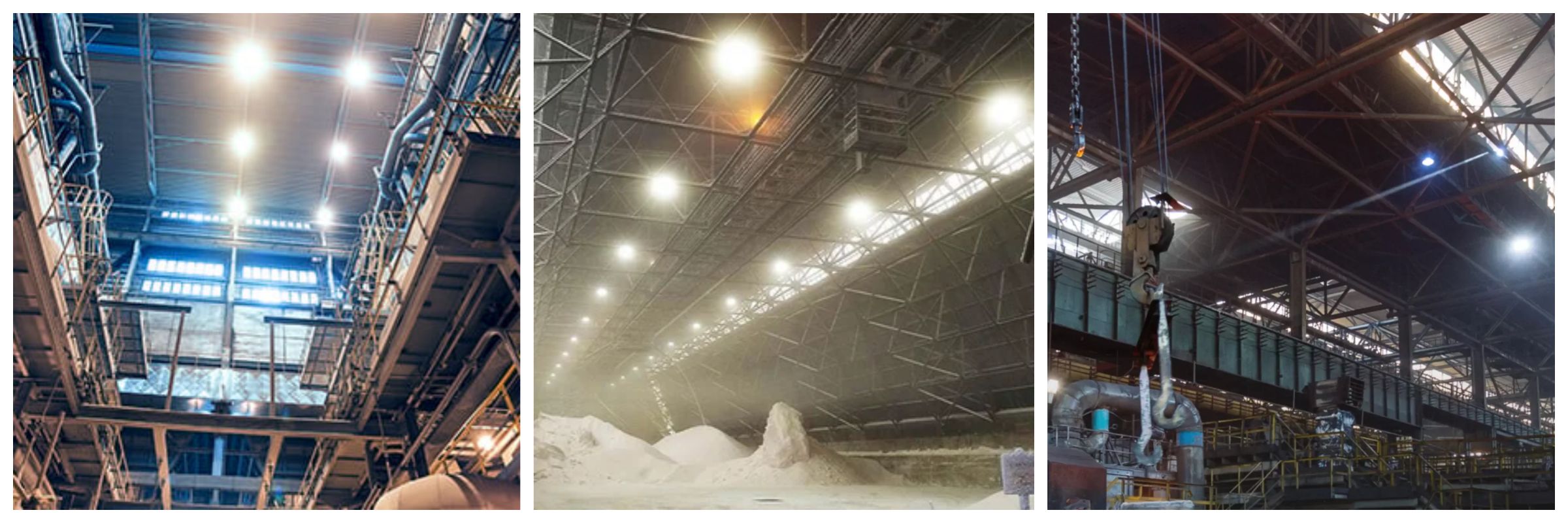
Certification is the reason to choose this body over a weatherproof high bay, and in explosion proof led high bay lighting it is the first thing an EHS reviewer checks. Inside, the LED module and driver sit behind a glass optic and a bolted cover with a gasket in the joint. What the fixture cannot decide for you is the zone. In industrial explosion proof lighting, suitability is set by the area classification of the space — zone, gas group and temperature class — not by wattage or housing style. Once that classification is known, the marking on the fixture can be matched against it, and the same document is what your safety team and your insurer will ask to see.
Fifty thousand hours is the figure to plan maintenance around. On three-shift operation that is measured in years rather than months, and in industrial explosion proof lighting the parts that decide whether a body gets there are all on the outside: a finned ADC12 die-cast section and a 6063-T5 extruded housing that pull heat away from the LED board, a glass optic that does not yellow, and a gasketed cover that keeps the interior dry.
The thermal path only works if the fins are left alone. Painting over them, lagging the body or boxing the fixture into a ceiling void all trap heat, and heat is what these fittings die of. In explosion proof led high bay lighting, the ceiling is usually the hottest place in the building, which is why the rated operating range of -20 °C to +60 °C deserves a second look before a fixture is placed directly above a furnace, a kiln or a steam line.
Because there is no lamp or ballast to change, the whole explosion proof high bay light fixture is the service item. That changes how a plant stocks: instead of a kit of tubes and ballasts, most sites keep one complete body and swap it, then service the removed unit on the bench in daylight.
Two habits shorten life more than anything else — closing the cover on a gasket that has been pinched or left out, and leaving a conduit entry without its seal. Neither shows up until the driver fails, and by then the cause has usually been forgotten.
| Area | Typical mounting position |
| Oil and gas extraction and processing | Over wellheads, manifolds and process skids |
| Oil and gas storage, transport and loading | Rack tops, loading arms and pump rows |
| Chemical plants | Reactor halls, pump floors and utility areas |
| Mining and mineral processing | Crusher houses, screens and conveyor transfer points |
| Natural gas stations and power plants | Turbine halls, gas skids and switchrooms |
| Grain storage and processing | Silos, elevator heads and milling floors |
| Food production | High-care halls and washdown areas |
| Spraying and coating | Preparation bays and booth surrounds |
| Pharmaceutical and hazardous materials warehousing | Aisle ends and dispatch docks |
| Public facilities and vessels | Plant rooms, tunnels and engine rooms |
| Property | Value |
|---|---|
| Model No. | HL181 |
| Power | 30 W – 50 W |
| Product dimension | Ø182 × 173 mm |
| Efficiency | 150 ± 10 lm/W |
| Luminous flux (±10%) | 4,200 – 8,000 lm |
| LED | SMD 3030 |
| CCT | 3000K; 4000K; 5000K; 5700K; 6500K |
| Ingress protection | IP66, IK10 |
| Wind resistance | Class 12 (32.7 – 36.9 m/s) |
| Colour rendering index | Ra > 70 |
| Beam angle | 110° |
| Driver brand | TOMCARLINE |
| Input voltage | AC 120 – 277 V |
| Power factor | > 0.9 |
| Frequency | 50 / 60 Hz |
| Driver type | Constant current (CC) |
| Luminaire net weight | 3.2 kg |
| Packing information | 1 pc / carton |
| Export carton size | 23.5 × 23.5 × 29.0 cm |
| Cable entry | NPT3/4 |
| Material | Housing 6063-T5, ADC12 |
| Optics | Glass |
| Fixture colour | Red / yellow / grey |
| Installation | Pipe / ceiling / bracket |
| Operating temperature | -20 °C to +60 °C |
| Life time | 50,000 hours |
| Dimmable | Non-dimmable |
| Certifications | UL, CE |
| Warranty | 5 years |
Every product we supply is CE and RoHS compliant, and we can send the matching declarations and test documentation with your order, so your safety, quality and brand audits have something concrete to check. Working through a network of certified partner suppliers, we verify each batch before it ships: current certificate version, label matching the report, and documents in the language your auditor expects. Tell us the standard your project is measured against and we will confirm what we can provide before you commit.


