


Work inside a Zone 0 area rarely happens where the fixed lighting reaches. It happens inside a vessel, under a loading arm, behind a pump skid, along a cable tray during a night shutdown — places where a person has to bring their own light. This rechargeable explosion proof led light is built for exactly that: a personal light that travels with the technician instead of lighting the whole bay.
It is deliberately a task light rather than an area flood, small enough to go with one person and designed with carry and mounting options that keep both hands free when the job needs them. The head sits on a bracket at the front of a compact body, so the beam follows the direction the unit is pointed instead of washing the ceiling.
The body is black ABS and ADC12 with orange control buttons, a clear faceted lens and a textured grip panel — a combination that stays findable on a cluttered deck and can be worked with a glove on. It is a companion to the fixed industrial explosion proof led lighting already installed on site, not a substitute for it: the fixtures light the space, this light lights the job.
Most buyers come to it from a wider industrial led lighting purchase — fixed fixtures, spares, cable and glands — and add one unit per technician. Maintenance technicians, electricians, inspectors, safety officers and turnaround crews are the people who end up carrying it, and the rule that decides the purchase is usually simple: ordinary torches are not permitted past the gate.
Zone 0 is the classification used for places where a flammable gas, vapour or mist is present continuously or for long periods. Equipment taken into that atmosphere has to be built so it cannot become the ignition source, and a light that is merely well sealed or water-resistant does not qualify. The certification on this led explosion proof lighting is the reason it can cross that line at all — it is the certificate, not the lumen count, that decides whether a light is allowed in. Before a unit goes on site, compare the marking on its body with the zone classification and any temperature class written on your permit. Explosion proof led lighting is certified against a defined set of conditions rather than every possible atmosphere, so this matching step is the one your EHS team will ask about. If your area sits under a different classification from the one on the unit, tell us before you order and we will confirm what applies. In service, the housing and lens are what keep the certification honest. Check them at the start of every shift: a cracked lens, a damaged seal or a distorted housing means the unit comes out of service until it has been assessed, and nothing inside the housing should be opened or changed while the light is in the zone. Treat it as sealed equipment, not as something to be repaired at the bench. Audit files usually need documentation that matches the marking. Send us the zone classification and temperature class on your permit before you order, and we will confirm what can be supplied with the shipment.
Choosing a level. High is for reach: sweeping a dark yard before entry, reading a level gauge from the ground, following a line of pipe to its next support. Medium is the setting most technicians leave it on for general inspection, because it still puts a clean pool of light on the work without draining the pack. Low is the close-work setting — a nameplate, a terminal block, a drawing — and after dark it keeps your eyes adapted to the space, which matters more than raw output when you are moving between lit and unlit areas.
Choosing a beam. The spot throws a defined circle that reaches further and shows detail; the flood spreads light wider across a work surface, a walkway or the inside of a compartment. The rule crews tend to use is simple: the spot is for looking at something, the flood is for working on something.
Light discipline. In a confined space an explosion proof led light fixture at full power bounced off stainless steel comes straight back at the operator, and a beam pointed the wrong way can blind a colleague on a ladder. Start low, step up only when the task needs it, and keep the head pointed at the work rather than across the deck.
Why the control layout matters. The led explosion proof lighting fixed overhead is set once and forgotten; a portable light is adjusted all shift long. Three levels cover almost every task on a hazardous site, and the middle one does most of the work.
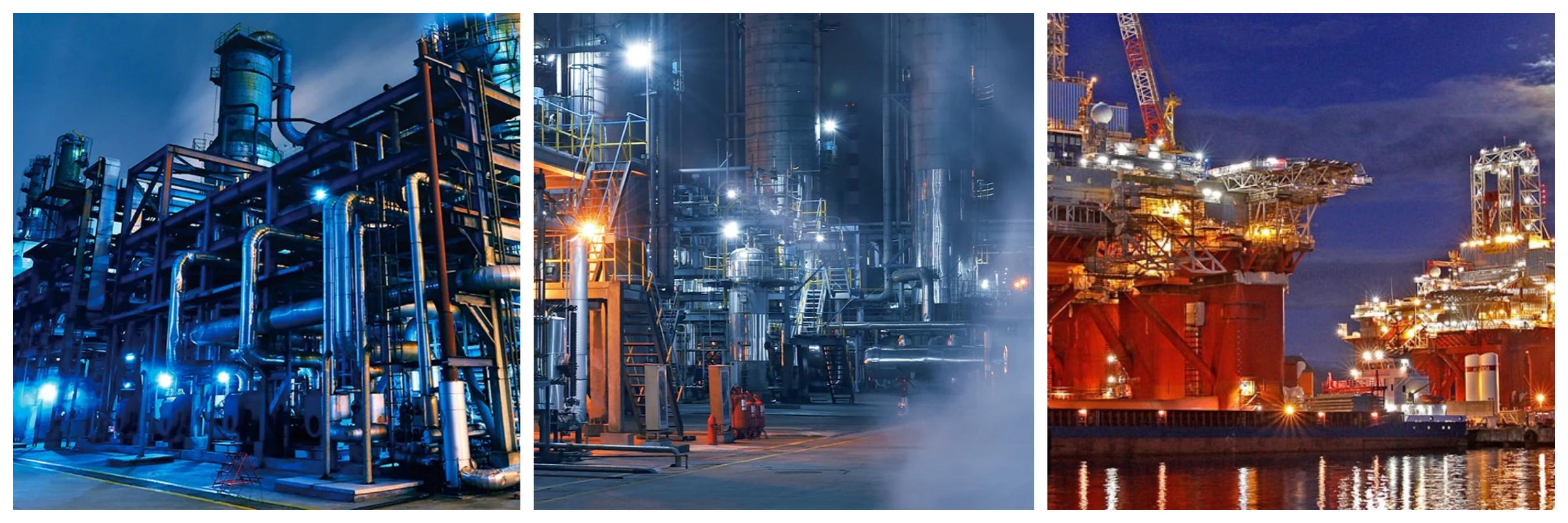
The light turns up wherever people work inside classified areas, across the industries we supply industrial explosion proof lighting to.
Oil and gas extraction and processing — wellheads, manifolds and process decks, where an explosion proof led light has to be carried onto a live deck for a valve check, a sampling point or a pressure reading.
Storage, transfer and loading areas — tank farms, rail and road loading arms, and barge or ship transfers after dark, with the beam aimed at a flange, a grounding point or a dip hatch rather than at the whole area.
Chemical plants — reactor buildings, pump rooms and sampling stations, where led explosion proof lighting is used for the walk-round before the daylight shift and for the check that follows a line break.
Mining and mineral processing — crusher houses, conveyor galleries and workshops where dust is constant, with the light carried along the walkway and set down at the drive head while a belt is inspected.
Gas stations and power plants — forecourts, compressor halls, turbine decks and switch rooms, for the night checks that cannot wait for daylight.
Grain, food and pharmaceutical sites — silos, mills, packing halls and hazardous-materials stores, where industrial led lighting usually means sealed washable fixtures and the portable light has to survive the same washdown routine.
Spraying and coating — booths, prep bays and solvent stores, where the atmosphere itself is the reason the work is done with this light and nothing else.
Public facilities and vessels — engine rooms, holds, plant rooms, tunnels and utility chambers where a maintenance team needs a light that can be hung, aimed and taken away at the end of the job.
- Explosion-proof for Zone 0 — the classification that decides whether a portable light is allowed past the gate on a hazardous site. - Three output levels — high, medium and low settings, so brightness can be traded for runtime instead of running at full power for a whole shift. - Spot and flood in one head — a tight spot for detail and a wide flood for a work area, without changing lenses or carrying two lights. - Sealed and impact-rated body — ABS and ADC12 housing, a polycarbonate lens behind tempered glass, and a textured grip panel that still holds when gloves are wet. - Caution light and buzzer alarm — a visible warning and an audible signal built into the body, so the led explosion proof light can call attention in a noisy or enclosed space as well as light it. - Rechargeable lithium-ion power — charged from a standard AC outlet with the cord supplied, so there are no disposable cells to source offshore or in the field.
| Model No. | HL201 |
| Power | 10W |
| Modes | High mode (10 m) / medium mode / low mode |
| Luminous Flux | ≥1000 lm (high) / ≥240 lm (medium) / ≥70 lm (low) |
| Run Time | ≥10 hrs (high) / ≥24 hrs (medium) / ≥80 hrs (low) |
| Light Beam | Spot light (20°) / Flood light (40°) |
| Carry Options | Hand hold / Ground lay / Shoulder strap / Magnetic absorption |
| Battery & Charging | Rechargeable lithium-ion battery; ≤11 hrs (fully charged) |
| Input Voltage | AC100-240V 50/60Hz |
| LED Quantity | 12 pcs (5050) |
| CCT / Color Rendering Index | 3000K / 5700K; Ra>70 |
| Warning Function | Caution light + buzzer alarm |
| Ingress Protection / IK Code | IP66 / IK10 |
| Operating Temperature | -20 °C to +40 °C |
| Material | Housing ABS and ADC12; optics PC lens + tempered glass |
| Fixture Color | Black |
| Dimensions / Net Weight | 267 × 100 × 132 mm / 1.7 kg |
| Lifetime | 50,000 hours |
| Product Dimension | 267*100*132(mm) |
| Operating temperature range | -20℃~+40℃ |
| Packing Information | 1PCS/CTN |
| Export Carton Size | 38.2*31*34.6(cm) |
| Gross Weight | 2.4kg |
| Warranty | 5 Years |
| Standard accessories | Soulder strap |
Every product we supply is CE and RoHS compliant, and we can send the matching declarations and test documentation with your order, so your safety, quality and brand audits have something concrete to check. Working through a network of certified partner suppliers, we verify each batch before it ships: current certificate version, label matching the report, and documents in the language your auditor expects. Tell us the standard your project is measured against and we will confirm what we can provide before you commit.


