Introduction
Have you ever installed LED tube lights that started flickering after only a few months? Or noticed that two LED tubes with the same wattage and lumen output perform completely differently over time?Many people assume the LED chips are responsible for brightness, efficiency, and lifespan. While LED chips are important, the real determining factor behind long-term performance is often the LED driver.In fact, many premature LED tube failures are caused not by the LEDs themselves, but by poor-quality drivers that fail to regulate power correctly.Whether you’re a facility manager, electrical contractor, business owner, or homeowner, understanding how LED drivers work can help you choose better products, reduce maintenance costs, and maximize lighting performance.In this guide, we’ll explain what LED tube light drivers are, how they work, why they matter, and how to identify a high-quality driver when purchasing LED tube lights.
What Is an LED Driver?
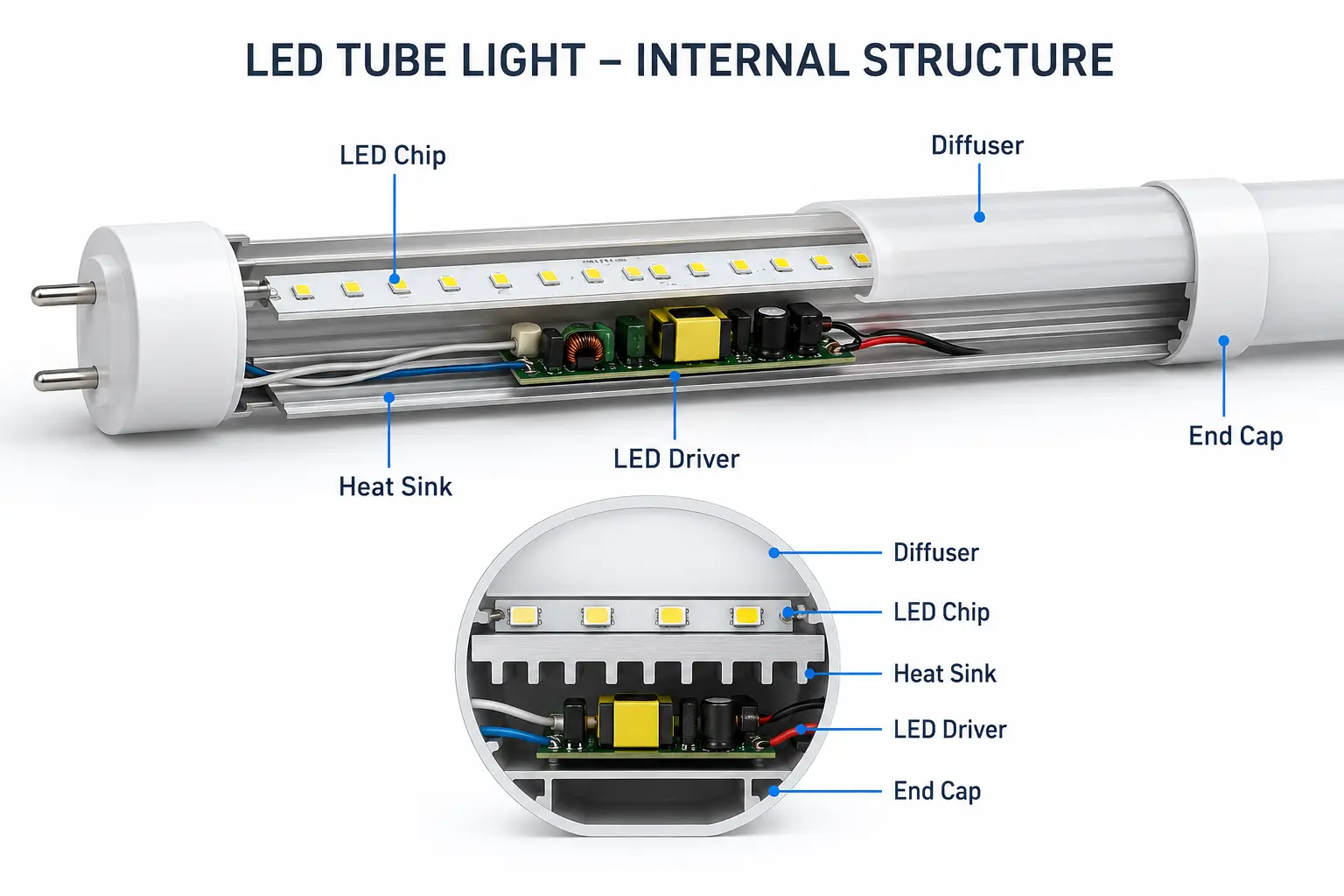
An LED driver is an electronic power supply specifically designed to regulate the electrical power delivered to LED chips.Unlike traditional incandescent lamps, LEDs cannot be connected directly to the electrical grid. They require a controlled amount of current and voltage to operate safely and efficiently.The driver performs several essential functions:
- Converts AC power into DC power
- Regulates current supplied to LEDs
- Protects LEDs from voltage fluctuations
- Prevents overheating and overcurrent conditions
- Improves overall system efficiency
Think of the LED driver as the “brain” of the lighting system. Even the highest-quality LED chips cannot perform properly without a reliable driver.
LED Driver vs Ballast: What’s the Difference?
Many people confuse LED drivers with fluorescent ballasts.A fluorescent ballast controls current in fluorescent lamps, while an LED driver regulates power for LEDs.Key differences include:
|
Feature
|
Ballast
|
LED Driver
|
|
Designed For
|
Fluorescent Lamps
|
LED Lighting
|
|
Output Type
|
AC
|
DC
|
|
Energy Efficiency
|
Lower
|
Higher
|
|
Lifespan
|
Shorter
|
Longer
|
|
Control Functions
|
Limited
|
Advanced
|
When upgrading fluorescent fixtures to LED tubes, understanding whether your installation requires ballast-compatible or ballast-bypass tubes is crucial.
How Does an LED Tube Light Driver Work?
The driver acts as a power management system between the electrical supply and the LED chips.The process typically follows these steps:
Step 1: AC Input
Electricity enters the fixture from the building’s power supply.
Step 2: Rectification
The driver converts alternating current (AC) into direct current (DC).
Step 3: Voltage Conversion
Voltage is adjusted to match the operating requirements of the LEDs.
Step 4: Current Regulation
The driver delivers a stable current regardless of fluctuations in the incoming power supply.
Step 5: Protection
Built-in protection circuits safeguard LEDs against surges, overheating, and electrical faults.Without these processes, LEDs would quickly degrade or fail.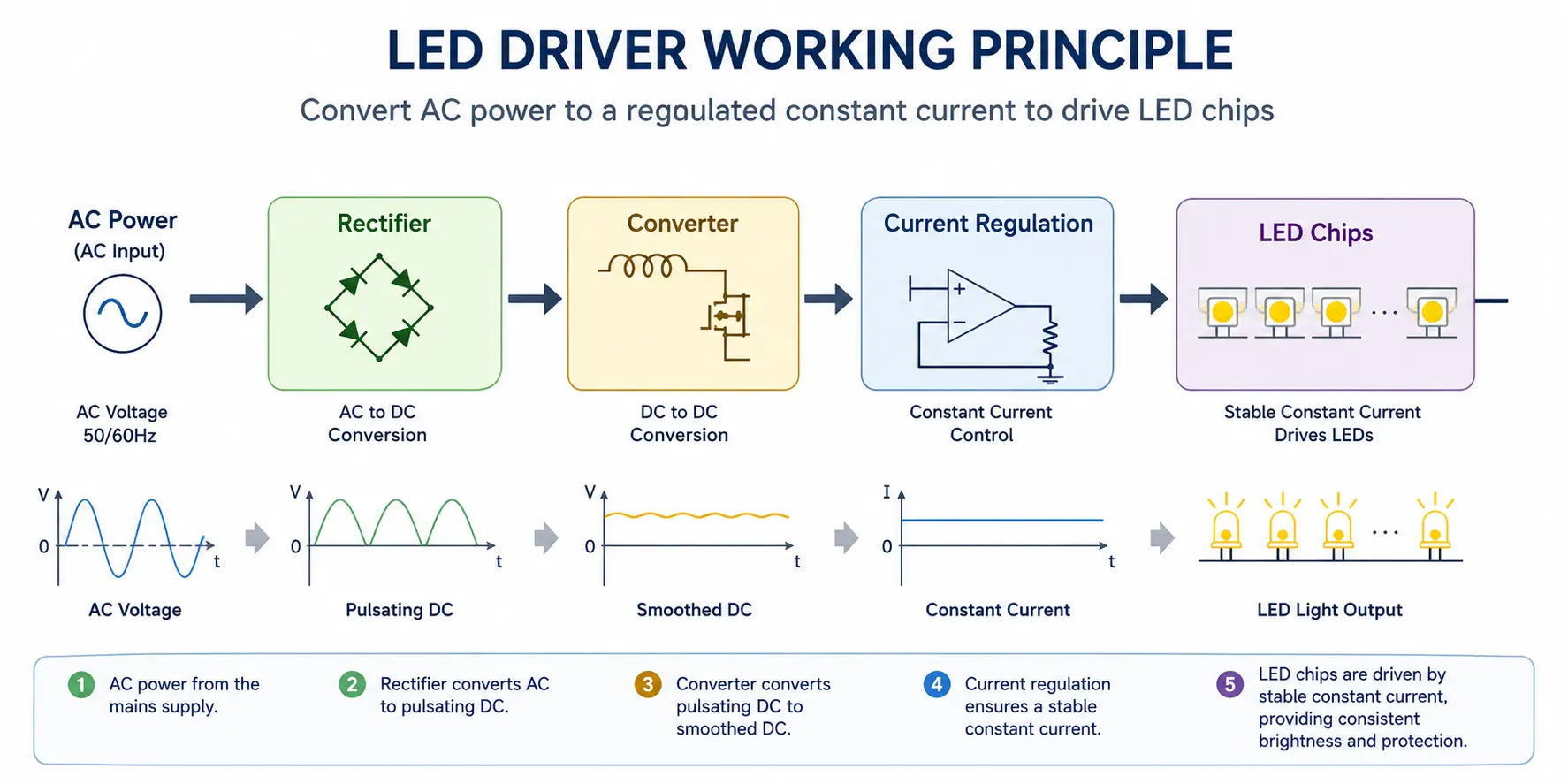
Why Is the LED Driver So Important?
Many lighting buyers focus on lumens, wattage, and color temperature.However, the driver often has a greater impact on long-term performance.
Current Control
LEDs are current-sensitive devices.Excess current can cause:
- Faster lumen depreciation
- Excessive heat generation
- Reduced lifespan
A quality driver maintains precise current regulation.
Voltage Stabilization
Power grids frequently experience voltage fluctuations.Without proper regulation, these fluctuations can damage LEDs or cause unstable operation.
Flicker Reduction
Poor drivers often produce visible flicker.High-quality drivers use advanced filtering technology to provide smooth, consistent illumination.
Thermal Protection
Heat is one of the biggest enemies of LED longevity.Modern drivers monitor temperature and reduce output when necessary to protect components.
Surge Protection
Commercial and industrial facilities are particularly vulnerable to power surges.Premium drivers include surge protection circuits that prevent catastrophic failures.
Energy Efficiency
Efficient drivers waste less energy as heat, improving overall system performance and reducing electricity costs.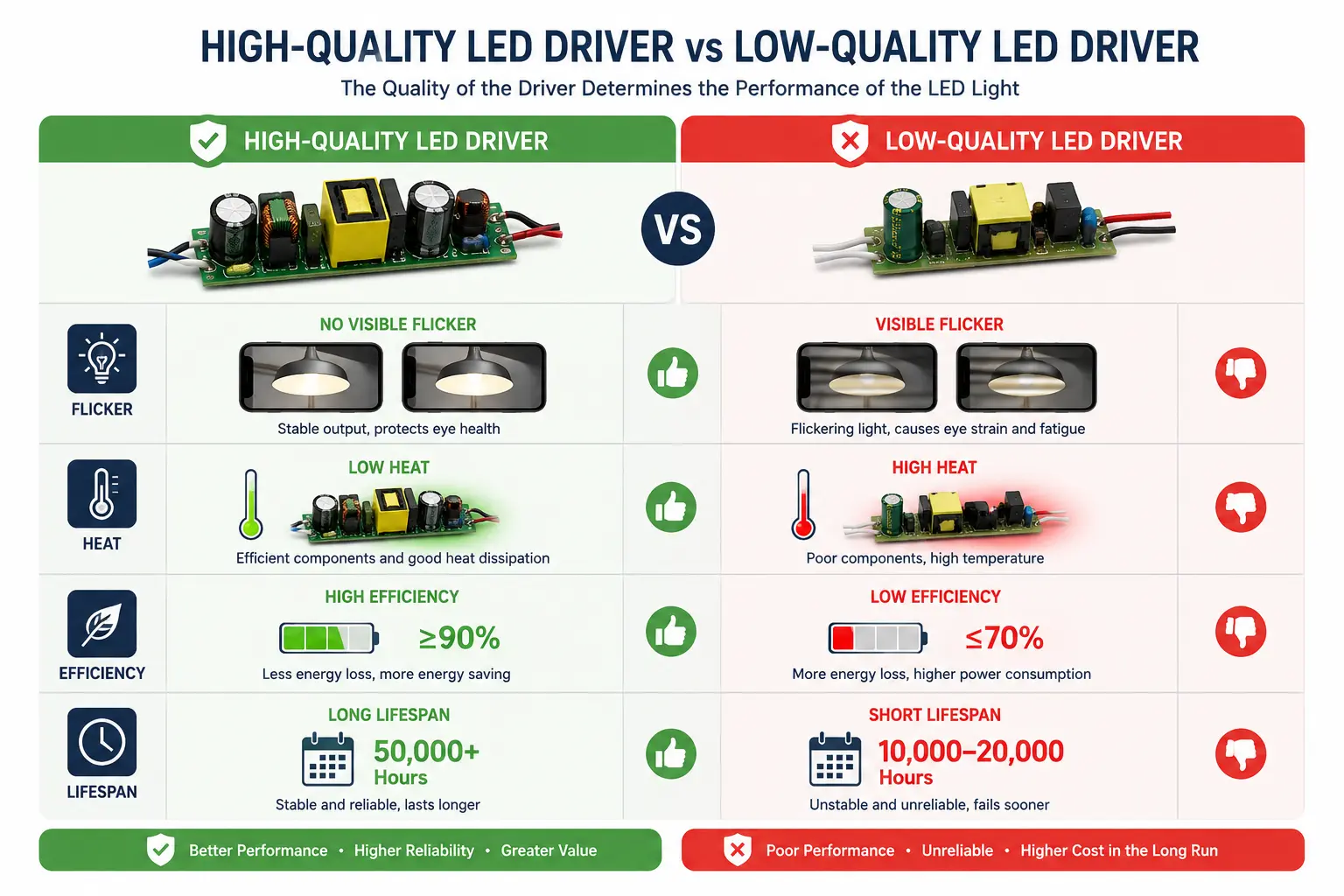
Common Symptoms of a Failing LED Driver
Recognizing early warning signs can prevent complete fixture failure.
Flickering Light Output
One of the most common signs of driver failure.Possible causes:
- Aging capacitors
- Voltage instability
- Internal component degradation
Delayed Startup
If the tube takes several seconds to illuminate, the driver may be struggling to regulate power.
Reduced Brightness
A deteriorating driver may no longer deliver sufficient current to the LEDs.
Random Shutoffs
Intermittent operation often indicates thermal protection activation or internal faults.
Excessive Heat
Overheating drivers usually signal poor efficiency or failing components.
Complete Failure
In many cases, the LEDs remain functional, but the failed driver prevents them from operating.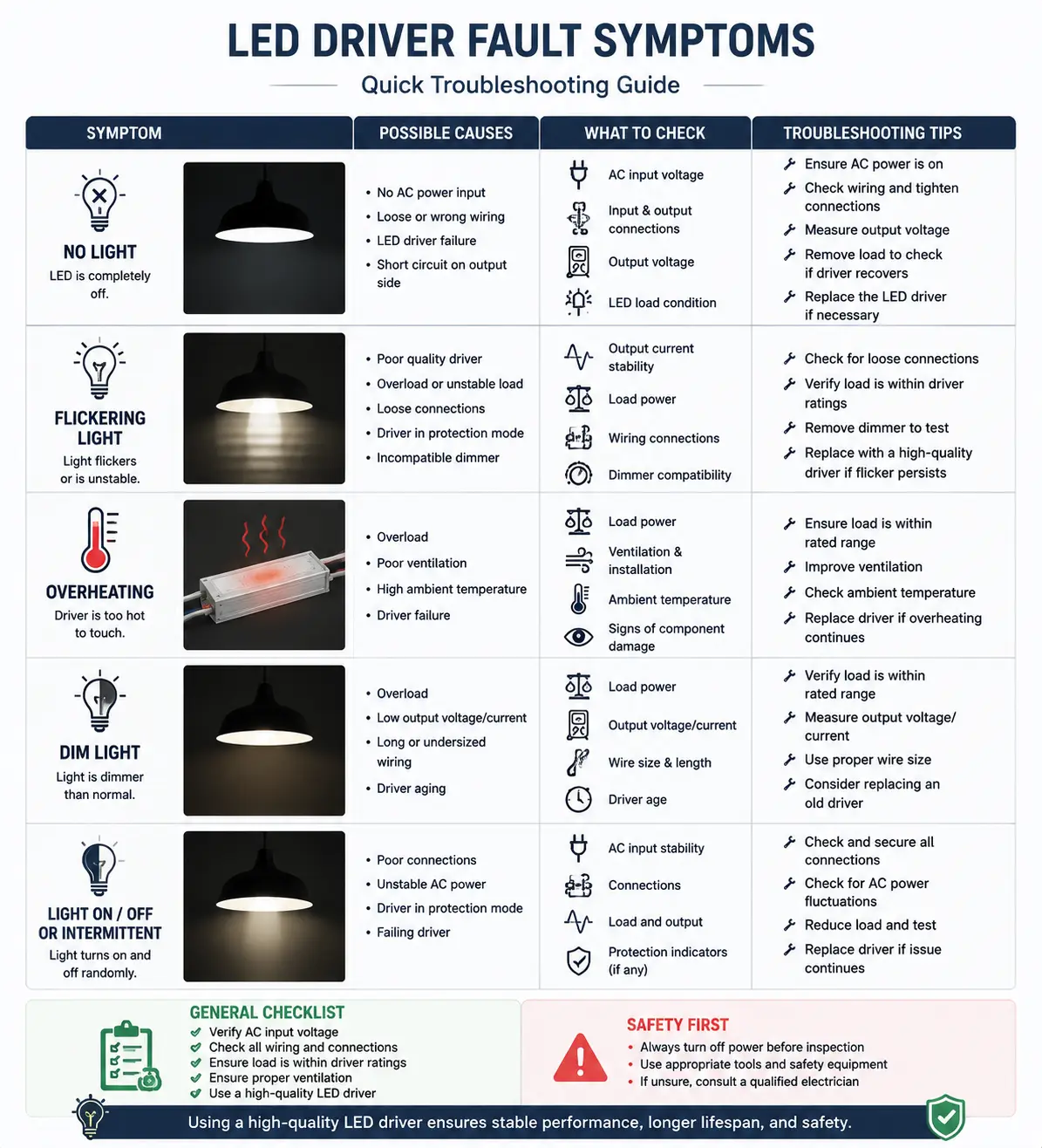
Why Do LED Tube Lights Flicker?
LED flicker is one of the most searched lighting problems online.Several factors contribute to flicker:
Driver Design
Low-cost drivers may not adequately smooth power fluctuations.
Voltage Variations
Unstable electrical supply can create visible fluctuations in light output.
Dimming Compatibility Issues
Using incompatible dimmers can cause severe flickering.
Aging Components
Capacitors inside drivers naturally degrade over time.Professional-grade drivers are designed to minimize flicker and improve visual comfort.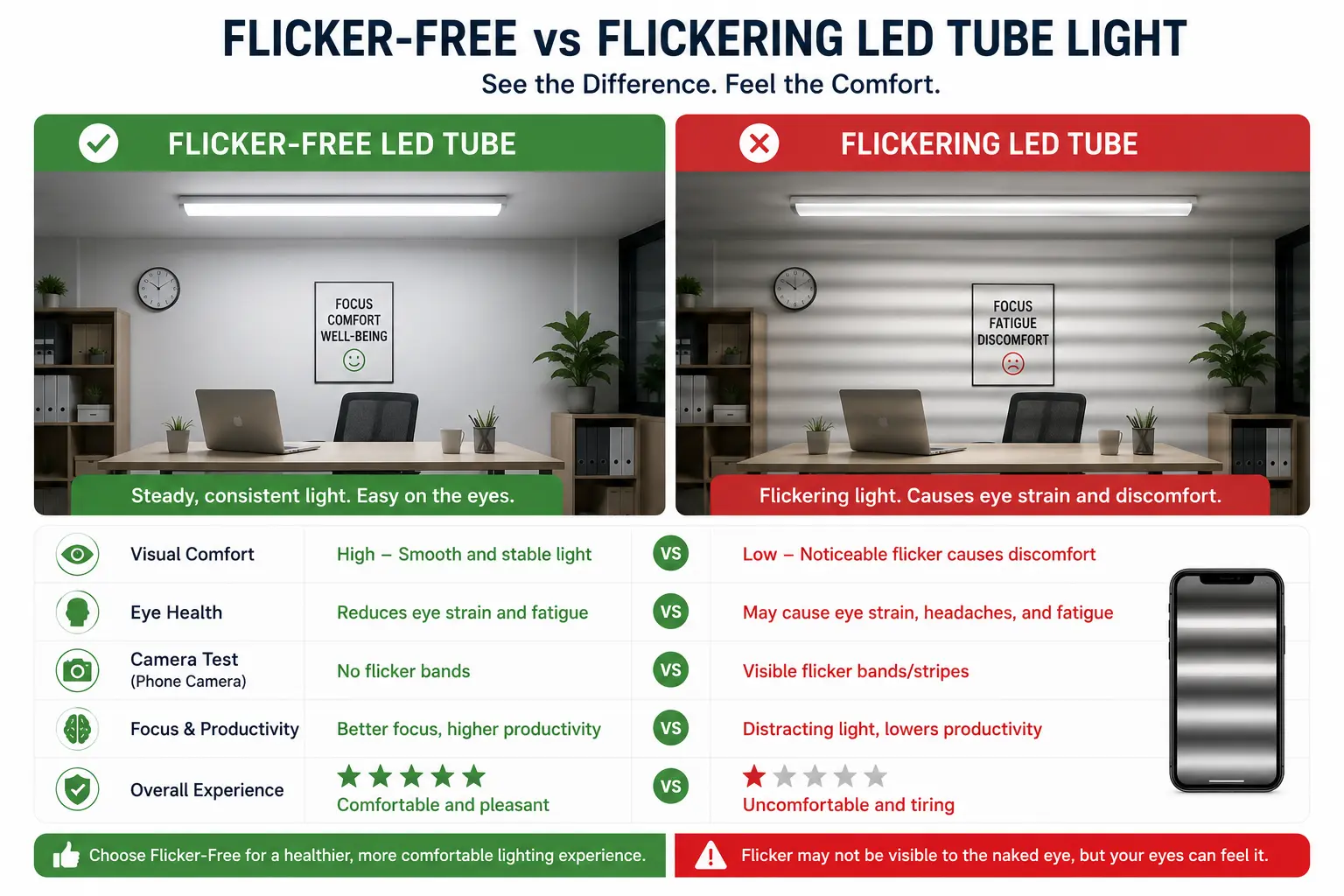
How Driver Quality Affects LED Tube Lifespan
Many LED chips are rated for 50,000 to 100,000 hours.However, the actual lifespan of a tube light often depends on the driver.
|
Driver Quality
|
Expected Lifespan
|
|
Budget Driver
|
10,000-20,000 Hours
|
|
Standard Driver
|
30,000-50,000 Hours
|
|
Premium Driver
|
50,000-100,000 Hours
|
Driver-Based vs Driverless LED Tube Lights
Advantages:
- Better current regulation
- Lower flicker
- Longer lifespan
- Greater reliability
Disadvantages:
Driverless LED Tubes
Advantages:
- Lower initial price
- Simpler design
Disadvantages:
- Less stable operation
- Greater susceptibility to power fluctuations
- Shorter expected lifespan
For most commercial and industrial projects, driver-based tubes are the preferred choice.
How to Identify a High-Quality LED Driver
When evaluating LED tube lights, check the following specifications:
Power Factor (PF)
Look for PF greater than 0.9.
Total Harmonic Distortion (THD)
Prefer THD below 20%.
Flicker Performance
Choose low-flicker or flicker-free products.
Surge Protection
Especially important for industrial applications.
Certifications
Look for:
Warranty
A warranty of five years or more usually indicates confidence in driver quality.
How to Troubleshoot LED Driver Problems
Step 1
Check incoming power supply.
Step 2
Inspect wiring connections.
Step 3
Measure driver output voltage.
Step 4
Check for excessive heat.
Step 5
Replace the driver if output values are outside specifications.
Applications Where Driver Quality Matters Most
Offices
Require low-flicker lighting to reduce eye strain.
Warehouses
Need surge protection and thermal reliability.
Retail Stores
Require consistent brightness and color quality.
Schools
Benefit from flicker-free lighting for improved visual comfort.
Hospitals
Demand highly reliable drivers with stable performance.
Frequently Asked Questions
Can a bad driver damage LED chips?
Yes. Excess current and voltage spikes can accelerate LED degradation.
Can LED drivers be replaced?
Yes, provided the replacement driver matches the electrical requirements of the fixture.
How long do LED drivers last?
Premium drivers typically last between 50,000 and 100,000 hours.
Why do LED tubes flicker after a few years?
Aging capacitors and internal component wear are common causes.
Are driverless LED tubes reliable?
They can be suitable for certain applications but generally offer lower performance and shorter lifespan.
What is the difference between a ballast and an LED driver?
A ballast controls fluorescent lamps, while a driver regulates power for LEDs.
Conclusion
When choosing LED tube lights, don’t focus solely on wattage, lumens, or color temperature.The driver is often the most important component affecting performance, efficiency, reliability, and lifespan.A high-quality driver can reduce flicker, improve energy efficiency, protect LED chips, and significantly extend the life of the fixture.For long-term value, always choose LED tube lights with premium drivers, proper certifications, low flicker ratings, and strong warranty support.References:
U.S. Department of Energy - LED Lighting Basics
https://www.energy.gov/energysaver/led-lightingDOE Solid-State Lighting Program
https://www.energy.gov/eere/sslIlluminating Engineering Society (IES)
https://www.ies.orgNational Institute of Standards and Technology (NIST) Lighting Research
https://www.nist.gov

